
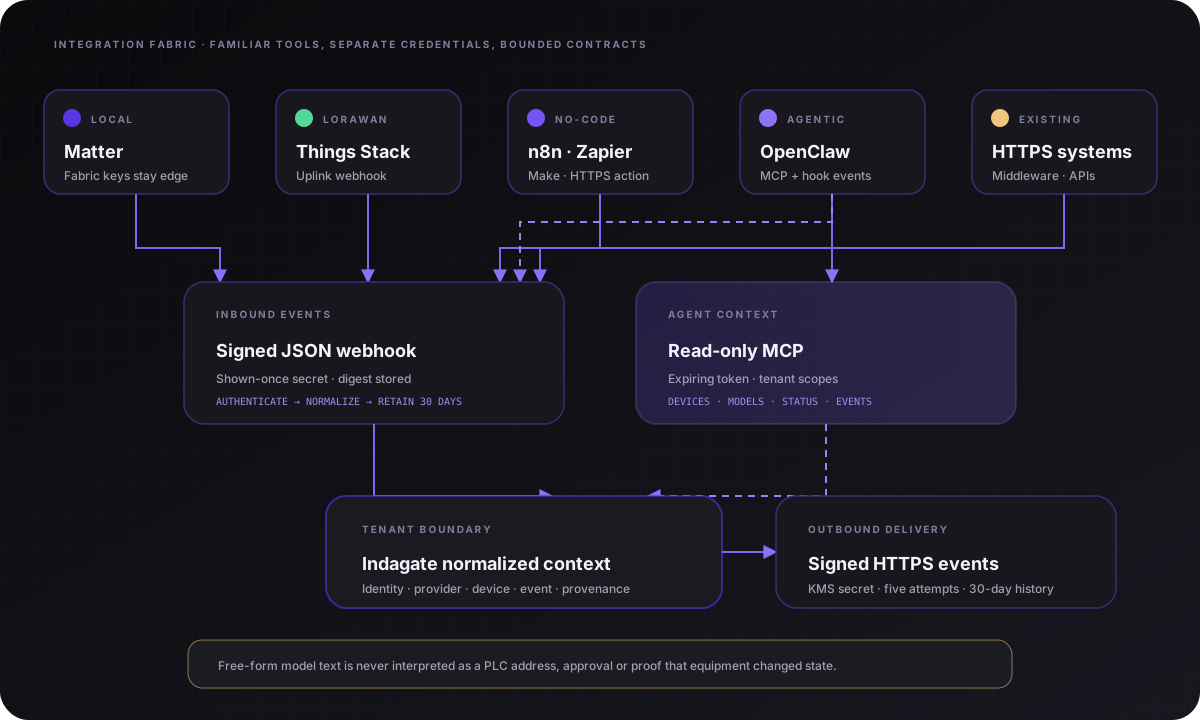
Live connectors
| Connector | Connection | Credential boundary |
|---|---|---|
| Matter | Local Oddessy Edge controller forwards normalized attributes/events | Fabric keys stay on the edge host |
| The Things Stack | Authenticated uplink webhook with decoded payload and radio metadata | Rotatable tenant bearer or Basic credential |
| OpenClaw and MCP agents | Read-only MCP for context; separate inbound and outbound webhooks for events | Expiring agent token plus independent inbound and outbound secrets |
| n8n, Zapier and Make | Guided HTTP/Webhook action with an in-browser safe test event | Rotatable tenant bearer credential |
| Generic HTTPS | JSON webhook for middleware, LLM workflows, IoT platforms and internal services | Rotatable tenant bearer credential |
| Signed outbound HTTPS | Oddessy lifecycle events delivered asynchronously with retry and 30-day history | Separate KMS-encrypted HMAC signing secret |
Guided setup in Platform
- Choose the connector name you recognise and whether data is entering or leaving Oddessy.
- For inbound integrations, copy the endpoint and shown-once credential into the sending system. For outbound delivery, register a public HTTPS receiver and store its shown-once verification secret.
- Send the isolated test event from the wizard.
- Confirm Verified or a successful outbound delivery before mapping real data.
Connector presets store the provider label for clearer operations, but all no-code and agent event presets use the same bounded, authenticated JSON ingestion contract. You are not locked into a proprietary workflow builder.
OpenClaw and LLM platforms
Use MCP when the agent needs to inspect devices, releases, model provenance, integrations or recent IoT events. Use an inbound webhook when an OpenClaw hook, TaskFlow or other LLM workflow sends a structured event into Oddessy. Use an outbound destination when that workflow must receive signed Oddessy lifecycle events. See OpenClaw's official MCP client and authenticated webhook guidance for its side of the connection.
The CLI and MCP adapter commands below document release-candidate interfaces pending npm registry publication. The hosted Streamable HTTP MCP endpoint is live.
# ODDESSY_API_TOKEN is injected into the OpenClaw Gateway environment
openclaw mcp add oddessy   --command npx   --arg -y   --arg @oddessy-io/mcp

openclaw mcp doctor oddessy --probeAn odd_pat_ MCP token, an odd_wh_ inbound secret and an odd_out_ outbound signing secret serve different paths and must be stored and rotated independently.
Matter commissioning
Matter discovery and commissioning occur on the local IP/BLE/Thread boundary, not through a public cloud webhook. Use the Platform to create a Matter integration, then configure the local bridge with its shown-once secret.
ODDESSY_WEBHOOK_SECRET=odd_wh_... npx @oddessy-io/cli matter bridge --integration int_... --webhook https://platform.oddessy.io/api/webhooks/int_...The bundled matter.js shell path is a reference/evaluation controller. Using it does not itself certify a shipping Matter device or controller.
Physical-control boundary
- Raw model text as a PLC register or coil address.
- An MCP tool as a safety interlock or emergency-stop path.
- Unbounded HTTP proxying from an agent into an OT network.
- An AI inference timeout as evidence that a controlled stop occurred.
PLC, SCADA, MES, CMMS, ROS 2 and fieldbus adapters remain deployment-specific because zones, conduits, interlocks and acknowledgement paths differ by site.