
Supported management targets
| Target | Management | Vision runtime |
|---|---|---|
| Oddessy QCS6490 reference hardware design | Full enrolment, telemetry, model ledger and verified OTA | Local reference VLM/VLA runtime |
| NVIDIA Jetson | Full enrolment, hardware profile, telemetry and compatible Linux OTA | GPU-scoped VLM/VLA packages admitted by manifest |
| Raspberry Pi 5 | Full enrolment, hardware profile, telemetry and compatible Linux OTA | OpenCV motion/edge/contour/ROI pipelines and compact task models |
| Existing ARM64/x86_64 Linux or Yocto-capable hardware | Full enrolment, telemetry and Linux OTA where compatible | Depends on measured resources, validated runtime and camera support |
| Zephyr companion MCU | Bounded serial telemetry through its paired edge node | Deterministic filters and small signal rules; no camera VLM |
| Windows 11 / Windows Server x64 | MSI-installed service, telemetry and model declarations | Management agent in v0.3; local VLM/VLA runtime is not implied |
Identity lifecycle
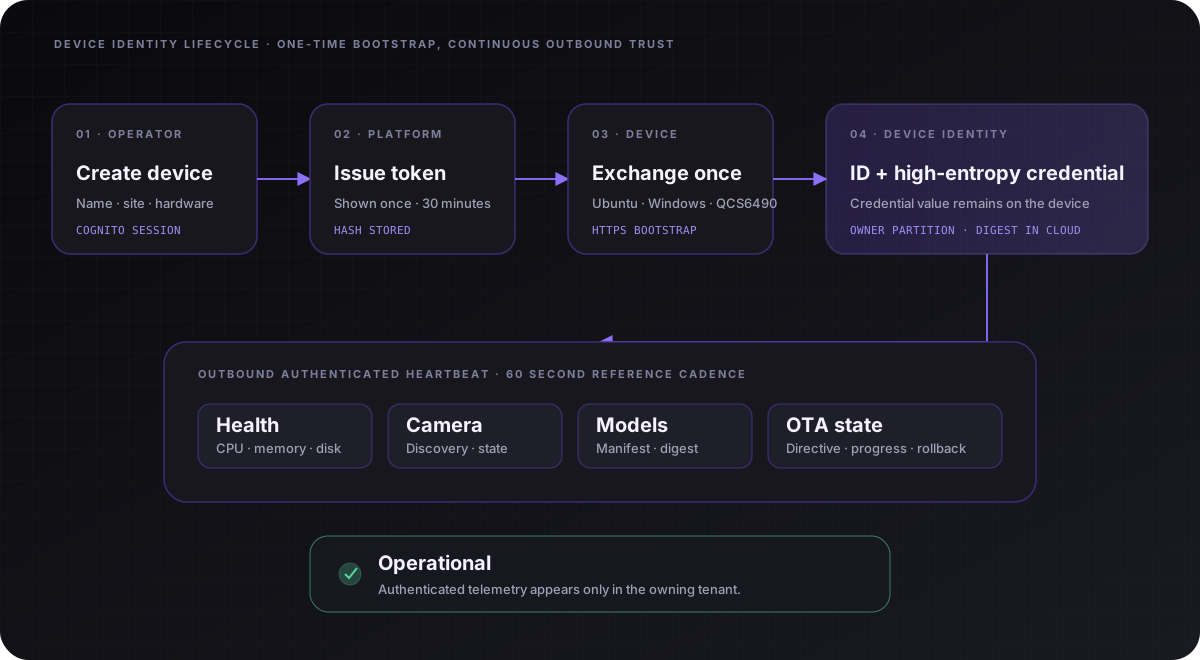
- A logged-in tenant user creates a 30-minute one-time enrolment token.
- The device exchanges it once for a device ID and a high-entropy device credential.
- The platform stores only the credential hash and associates the device with the user subject.
- Every heartbeat supplies the device ID and credential over HTTPS.
Heartbeat fields
Current telemetry includes hardware and OS identity, detected hardware profile, OpenCV/accelerator-tool availability, agent version, CPU/memory/disk health, camera discovery, local model scope/provenance, vision state and OTA status when applicable.
Offline state
A device becomes offline when its last authenticated heartbeat exceeds the configured freshness interval. Public hosted status does not include customer devices unless a separate status integration is agreed.